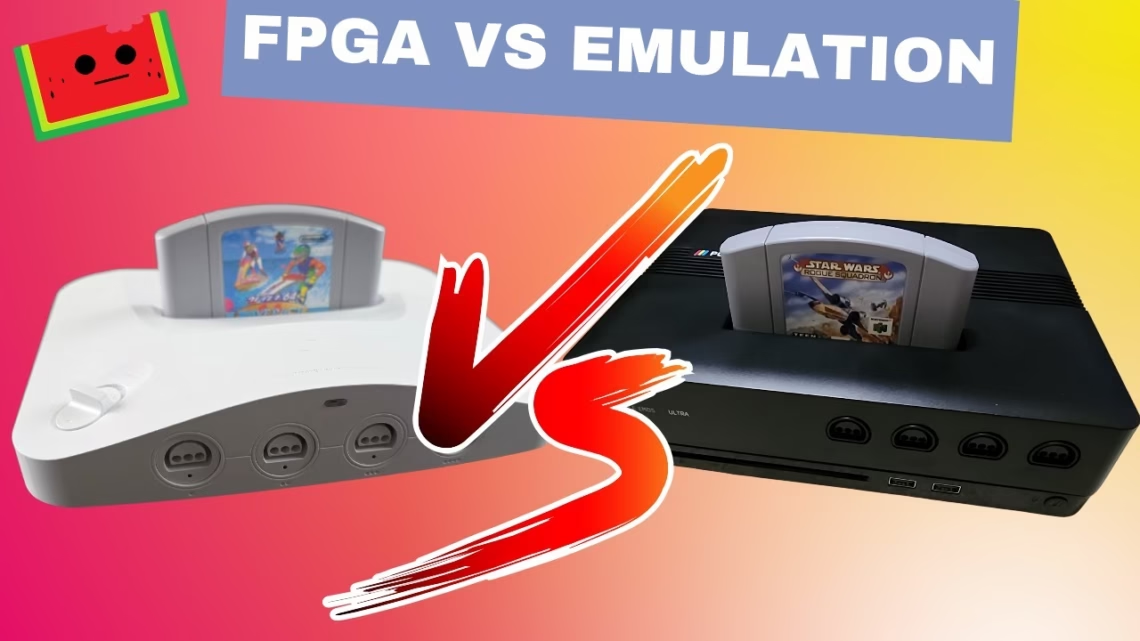
Both the Analogue 3D and the Polymega Ultra Module let you play your original Nintendo 64 games, in very different ways. They aren’t exactly the same kind of hardware, but we thought it would be fun to compare them in four categories: build quality and design, features, performance, and price and value.
The two systems
The Analogue 3D is Analogue’s latest FPGA system for N64 games. Analogue uses Field-Programmable Gate Array chips to behave like the internals of an original Nintendo 64, so you get as close to the original hardware as possible.
The Polymega is more like a PC with custom software that emulates many systems, including the NES, Super Nintendo, PlayStation and Sega CD. The Ultra Module attachment lets it play original N64 cartridges. Unlike the Analogue 3D, it uses software emulation.
Build quality and design: Analogue 3D
The Analogue 3D is a thing of beauty. It resembles the original N64 with a sleeker, more modern look, and feels engineered, like a Mazda RX-7. We have the white version and it looks amazing. The front LED doubles as the Bluetooth pairing button, a small LED near the controller port shows which port is active, and if you have an 8BitDo 64 controller you can turn the console on with it. The bottom has a rubber mat that grips well, the cartridge slot accepts games from all regions, and it supports four controllers like the original. Our only complaint is how much force it takes to remove the included SD card.
The Polymega is more like a Honda Element: boxy and functional. It’s designed to take modules from different consoles, so we can’t fault it too much. The Ultra Module slides into rails and adds four N64 controller ports and a very grippy cartridge slot. The Polymega also has a microSD slot, an M.2 NVMe slot for storing games and two USB-A ports on the front.
Features: Polymega Ultra
The Analogue 3D’s main feature is FPGA hardware that emulates the N64 at a hardware level. It can overclock some games so they run smoother, outputs 4K over HDMI 2.1 with HDR, has CRT and PVM display modes (we prefer the clean look), supports Bluetooth controllers including the 8BitDo 64, has two USB ports and an SD slot, and works with our SummerCart64 for homebrew and ROMs.
Its software, 3D-OS, is very limited. Inserted games show up in the UI and you can adjust display and hardware settings per game. Custom artwork is supported but has to be installed manually. With wireless controllers it provides a virtual Controller Pak or Rumble Pak, enabled automatically depending on the game, and you can switch in-game with Select on the 8BitDo 64 controller.
The Polymega has an amazing interface by comparison, with automatic artwork, descriptions and banners. Insert a game and everything is handled. You can install games to an SD card, NVMe or local storage and no longer need the cartridge to play. It supports save states and virtual Controller and Rumble Paks. It does not support flash carts like an EverDrive or SummerCart: you just get a blank screen.
Performance: Analogue 3D
The Analogue 3D is the best performer here, even outperforming the original console. Games show better colours and look sharp with a richer palette without changing the feel, and overclocking can make games run better than on the original. The one thing it doesn’t do is upscale graphics. We understand that wasn’t what Analogue promised, but seeing how sharp Wave Race 64 looks on Nintendo Switch Online makes you wonder.
The Polymega’s performance is okay but not great. Games look drab next to the Analogue 3D and the hardware seems to struggle with N64 emulation. Plenty of settings are adjustable, but the lack of meaningful upscaling is disappointing for software emulation.
Price and value: neither wins
The Analogue 3D costs $249.99 in white or black, around $300 with taxes and shipping, without a controller. The 8BitDo controller is another $40. Analogue is known for cancelling orders after checkout, so consoles end up with scalpers on eBay, and it releases new colours just days after early backers receive theirs, which feels like a cash grab. We think its business practices need to change.
The Polymega is about $350 with taxes and shipping, plus $89 for the Ultra Module. Its real advantage is playing multiple systems, but it took us two years to get ours. Availability has improved, but they’re still hard to find.
Because of this we can’t recommend either system strictly for N64 gaming. If you already have a computer there are great ways to emulate N64 games for far less, and Nintendo Switch Online isn’t bad either.
Verdict
The Analogue 3D wins 2 to 1. We really enjoyed playing on it, and it made us start collecting for the N64 again. We just wish Analogue treated its loyal customers better. The Polymega is still our go-to for CD-based games. If you want to play original cartridges as accurately as possible, get the Analogue 3D. If you want convenience and multiple systems, the Polymega may suit you. Prices were correct when we recorded the video and may have changed.